Showing posts with label Korfhage. Show all posts

Sunday, August 4, 2024

Story of Peter Heinrich Westerhaus and Anna Maria Holtcamp - Part 2

Stories Continues ...

Peter would have left Eudora, Douglas, Kansas, for Lexington, Lafayette, Missouri, to be present for his 5 Mar 1863 court trial. Court records show he was not able to arrive in time, and the trial was rescheduled for 15 Apr 1863.  Back in Kansas, Anna and the five children were trying to survive on Peter's and Anna's newly chosen farm. Based upon Westerhouse family stories, Anna purchased a larger home up on a nearby hill.  This has been shown by a property deed found at the Douglas County Courthouse, indicating she had purchased 80 acres 25 Mar 1863 for $400. This land was located at the North Half of the Southeast Quarter (2392 North 800th Road) of Section 3 in the Captain Creek area of Eudora. The property deed listed only her name, as Peter was away at his trial in Lexington at the time.

Back in Missouri, Peter arrived at the courthouse for his trial 15 Apr 1863 and plead not guilty to both the first charge of 'attempting to entice and decoy away slaves' and the second charge of 'bribery'. Peter was tried on 22 Apr 1863 and jurors were not able to agree on upon a verdict. A mistrial was declared, and a new trial was scheduled for 24 Nov 1863. 

Lexington Weekly Newspaper - 18 Apr 1863


Back in Eudora, Douglas, Kansas, Anna would continue to do the best she could on her own with five children. In early Aug 1863, Quantrill, a bushwhacker from Missouri, was planning a large attack on Lawrence, Douglas, Kansas, a town just west of Eudora. Quantrill and his men gathered east of Eudora to plan the attack. Based upon Westerhouse family stories, Quantrill's men came to Anna's farm and took chickens, eggs and any other food she had available. Quantrill and his men rode through Eudora 21 Aug 1863 on their way to Lawrence to burn it to the ground.  Quantrill and his men returned to Missouri and celebrated their victory.  Peter must have been worried about Anna and his family when he heard the news. He was in Lexington, Lafayette, Missouri for his trial and had no way to find out if Anna and their children were safe.

Peter came for trial on 24 May 1864 and plead not guilty on both counts with which he had been charged.  The 'jurors were elected, tried and sworn in'. The trial proceeded, the jurors discussed the evidence presented during the trial and came to an agreement upon the following verdicts:
   Guilty on count one, 'attempting to entice and decoy away slaves'
   Not guilty on count two, 'bribery'

The jurors recommended punishment by imprisonment in the penitentiary for three years based on the law. They recommended Peter be pardoned from punishment.  They had found him guilty of breaking the law but did not agree with the law.  Public opinion was beginning to change about slavery.

Peter's conviction was suspended until 8 Jun 1864 to receive the results of a pardon request to be filed by the County Clerk. After the trial, County Clerk Richard Vaughn submitted a pardon request with a handwritten letter to Governor Willard Preble Hall. Governor Hall, after reviewing the request, issued a pardon for Peter on Saturday, 4 Jun 1864.

Peter arrived for his court trial 8 Jun 1864 to hear the results from the pardon request. The court informed Peter that Governor Willard Preble Hall had pardoned him for his crime. The Court ordered Peter to be discharged upon payment of his debt.  

Peter Westerhouse Pardon Card

Peter returned to Eudora, Douglas, Kansas from the trial during Jun of 1864. He would most likely have started to farm the land which Anna had bought while he was away. It was not long before he was drafted by the Union army. Peter was drafted 23 Feb 1865, from the 34th Sub-District Eudora and Willow Springs. Peter was listed as 100% for deficiency, meaning he could provide a substitute soldier instead of serving in the war himself. No civil war records have been found for Peter in Kansas.

The Peter Westerhouse family attended the Captain Creek German Methodist Church in Eudora, Douglas, Kansas. It was established in 1859, and services were conducted in German at church members’ homes until the Captain Creek Church was built in 1882. The church building was located near the northeast corner of West 146th Street and 2400 Road.

Captain Creek Methodist Church (photo by Otta Rosena)

Following the end of the Civil War, the Peter Westerhouse family continued to live on the farm which Anna had purchased in the Captain Creek area of Eudora, Douglas, Kansas. Peter was able to return to farming fulltime to provide for his growing family.  He soon realized he needed more land, so he and Anna decided to sell the farm and purchase a larger one. The Peter Westerhouse family planned to purchase the 160-acre plot of land which they had originally homesteaded unsuccessfully. They first sold their current farm, 8 Sep 1865, for $1500, according to a property deed found at the Douglas County Courthouse. This represented a $1,100 profit from the $400 price Anna had paid a few years earlier.

According to another property deed found at the Douglas County Courthouse, Peter purchased a 160-acre farm 16 Oct 1865 for $1000. This property was located at the Northeast Quarter (2375 North 800th Road) of Section 10 in the Captain Creek area of Eudora, Douglas, Kansas. This property was less than a mile south of the farm they had just sold. Peter and Anna must have been excited to return to the place where they had originally chosen to live in Kansas. Based upon family stories, they built a home between two willow trees, near Captain Creek on the southern part of their property. Peter was looking forward to planting more crops and adding more livestock. During Jan 1865, Henry Eggers, a local farmer, had bought an 80-acre farm south of the Westerhouse farm. Henry would help Peter and Anna from time to time.  He had recently been divorced and was living alone on his farm.  Peter and Anna must have been happy to have him as a neighbor.

Peter and Anna had three more children during the next four years:  

William Westerhouse, 14 Sep 1866

Aurelia Westerhouse, about 1869

Amos Westerhouse, 6 Jun 1870

According to the Sep 1870 Federal Non-Population Census, Peter's farming business was successful. The census indicated that he owned 160 acres of improved land and 5 acres of wooded land. His farm property was valued at $4,400 and the farm equipment was valued at $700. The census also listed that Peter owned 9 horses, 5 mules, 7 milch (milk) cows, 2 cattle and 30 swine with the livestock value of $1,400.  In addition, the census showed 300 bushels of spring wheat, 2,000 bushels of Indian corn and 500 bushels of oats on hand.

The 7 Jul 1870 Federal Census indicated Peter was a farmer who was born in Prussia.  His parents were listed as being foreign born and Peter as being a United States Citizen. His real estate was valued at $4,475 and the value of his personal estate was recorded as $2,700. The census shows Anna was keeping house, their son, Henry, was attending school.  Another son, Amos, was not listed on the 7 Jul 1870 Federal Census, however his death certificate indicated he was born 6 Jun 1870.

After seven years, Peter and Anna decided to sell the farm because it was becoming more difficult for Peter to farm the land due to poor health. The farm sold 7 Oct 1872, for $3,700 at a profit of $2,700.  The property deed found at the Douglas County Courthouse verified this. It is not known where the family lived after selling the farm.

The 1 Mar 1875 Kansas Census reported Peter's occupation as farmer, his place of birth as Germany, the value of his real estate as $1,600 and the value of his personal estate as $600. It showed that Anna was keeping house, and their son Henry was farming. The census showed Henry Eggers was farming the adjoining property with the value of his real estate as $800, the value of his personal estate as $200 and his place of birth as Germany.

Peter’s original headstone had a death date of 9 Oct 1876, and his current headstone has a death year of 1876. It is unclear why his two headstones have a different death year from the obituary. He was buried Deay Cemetery in Eudora, Kansas, located near his 160-acre farm, at the southwest corner of North 800 Road and East 2300 Road (799 East 2300 Road).

Peter Westerhouse obituary (Republican Journal) - 29 Oct 1875

Soon after Peter's death, Anna married Henry Eggers, the farmer living to the south of the Peter Westerhouse farm.

Anna Westerhouse and Henry Eggers marriage license – 1 Feb 1876

Anna moved with her five children to live with her new husband, Henry Eggers. Henry and Anna raised the minor children into adulthood. All the children, except William, married and left home to start their own lives. William never married and continued to live with Anna and Henry, as was documented by the 1880 Federal census. Entering the 20th century, Anna and Henry would only have William living at home. The 1900 Federal Census shown below, indicated Henry was 67 years old, born Oct 1832 and had been married for 20 years. Anna was listed as 67 years old, born Sep 1832, had been married for 20 years and had eight children of which six were living. The 1905 Kansas Census showed Henry, Anna and their son, William, living in a house on their farm in Eudora, Douglas, Kansas. The Amos Westerhouse Sr. family rented the farm next door.

Henry Eggers died 5 Mar 1908, and is buried at Deay Cemetery in Eudora.

Anna would continue to live on the farm with her son, William, until she was not able to maintain it. The 1915 Kansas Census showed Anna and William living with the Amos Westerhouse, Sr. family. She would later move to Eudora, to live with her oldest daughter, Mary Westerhouse Edler Clark.  

Anna Westerhouse Eggers was buried next to her 2nd husband, Henry Eggers, at Deay Cemetery in Eudora, Kansas.

All the Westerhouse and Eggers headstones were replaced with new ones while Anna was buried during 1916. 


During May 1979, Peter's original headstone was dug up in Lawrence by a construction company. They discovered it being used as a well cover.  At the time it was found, it was not known where it had originated. Amos Westerhouse Jr., Peter's grandson, saw an article and picture in the paper. He wrote a letter to the Lawrence Journal World describing who Peter Westerhouse was, and where the headstone had previously been. Today, that original headstone of Peter Westerhouse is being preserved for future generations to view at the Eudora Area Historical Society in Eudora, Kansas.


Lawrence Journal World - 2 May 1979

Original Headstone of Peter Westerhouse

Ann Eggers Obituary - Lawrence Journal World – 7 Dec 1916


Sunday, July 28, 2024

Story of Peter Heinrich Westerhaus and Anna Maria Holtcamp - Part 1

Peter Westerhaus is my second great grandfather that immigrated to America during 1847. 

Peter was born on his parents’ farm, located at #18, Lenzinghausen, Herford, Westphalia, Prussia. He was christened 23 Mar 1828 at St. Martin Lutheran Church in Spenge, Herford, Westphalia, Prussia. Church records show he was the 54th birth registered, and time of birth was 7 pm.

Peter Heinrich Korfhage birth record - St Martin Lutheran Church

Column two listed his given name as Peter Heinrich.  Column three listed his birthdate as 17 March. Column four listed his time of birth as 7 pm.  Column five listed him as born in wedlock.  Column six listed his father as Johann Heinrich Korfhage, owner of farm #18. Column seven listed his mother as Anna Maria Ilsabein Brandt.

As an infant, Peter moved with his family to the Westerhaus farm #14, located across from the Korfhage farm #18, in Lenzinghausen, Herford, Westphalia, Prussia during 1829. After Peter's family moved to the Westerhaus farm #14, the family gradually changed their last name from Korfhage to Westerhaus, in keeping with the name of the farm they had purchased. Peter's father, Johann Heinrich Korfhage, died 23 September 1835, on the Westerhaus farm #14, which he had purchased five years earlier when Peter was seven years old.  

Peter immigrated to America with his mother, Anna Maria Brandt Korfhage and three sisters, Catharina Ilsabein, Anna Catharina, and Anna Ilsabein during 1847. This was documented in the Herford District Departure Records. Both the names, Westerhaus and Korfhage, were referenced in these records.

Herford District Departure Record of Anna Maria Korfhage and Children

They most likely would have traveled with a group of families from the Spenge area.  They were part of a mass migration from Prussia to America, as noted in the Departure Records. 

The family traveled over land, to Herford, 10 miles east of Lenzinghausen. In Herford, boarded a small barge, and traveled 15 miles up the Werre River to Bad Oeynhausen. In Bad Oeynhausen, they boarded a barge of the same size on the larger Weser River and traveled north for 155 miles, arriving in Bremerhaven. Along the way, they worked for a few days or weeks to help pay for the expense of the barge trip to Bremerhaven.  

The family boarded a sail ship for America, following the path of the Johann Heinrich Uphaus family, very close friends from Lenzinghausen. No passenger list has been found, but it is assumed from Westerhouse family stories passed down from generation to generation, that they followed the Uphaus family. Documentation has been found indicating the Uphaus family arrived in New Orleans during December of 1847 after sailing for 6 weeks.  
Once arrived in New Orleans, they stayed only a short time before boarding a Mississippi River barge and traveling north to St. Louis, Missouri. Boat records were not required at this time in America, and no records have been found.  

Once in St. Louis, the family would have stayed through the winter before taking a Missouri River barge west to Lexington, Lafayette, Missouri. Peter Westerhaus would then stay in Lexington, while his mother and his sisters would join his brother, Caspar Westerhaus, in Freedom, a German community 25 miles southeast of Lexington.

Missouri River at Lexington, Lafayette, Missouri - 1869

In Lexington, Peter gradually changed the spelling of his last name from Westerhaus to Westerhouse, and dropped his middle name, Heinrich.

Peter purchased property on 16 Jan 1852, for $250. It was located at 317 3rd Street (824 Highland Avenue) in the First Addition section of Lexington. The property was located across from a lumber yard. The lumber yard would have supplied Peter with material for building wooden barrels as a cooper. Peter's home was a two-story log building, based upon information from an 1885 Sanborn Fire Insurance map. The first floor was used for his cooperage business, and he lived on the second floor. The property was on a bluff overlooking the Missouri River. This was a busy area of the Lexington business district. Along one side was Commerce Street, which declined sharply to the Missouri River. Wagons of goods traveled up and down Commerce Street to be loaded and unloaded onto steam ships. Along 3rd Street were Pro-Confederate Antebellum homes overlooking the bluff. 3rd Street also served as the route for the Santa Fe Trail through Lexington, on which many wagons of goods and settlers traveled west.

Partial map of Lexington, Lafayette, Missouri - 1869

Before marriage, Anna Holtcamp immigrated with her father, Herman Heinrich Holtcamp and her brother, John Holtcamp and her sister, Mary Elizabeth Holtcamp during 1845. The family departed from Bremen, Prussia and arriving at New Orleans, Louisiana.

Peter married Anna Maria Holtcamp on 19 Apr 1853, in Lexington, Lafayette, Missouri, according to the marriage record found at the Lafayette County Courthouse.

Marriage Record of Peter Westerhouse and Anna Holtcamp

Peter and Anna purchased the following properties after marriage:
19 Jun 1854, for $300; 318 3rd Street (820 Highland Avenue)
27 Sep 1858, for $275; 319 3rd Street (816 Highland Avenue)
19 Jan 1859, for $75; 8 Commerce Street
31 Dec 1859, for $175; Poplar Street, north of Delaware Street
31 Dec 1859, for Unknown amount; Cedar Street, north of Delaware Street
3 Dec 1860, for $800; 3rd and Plum Streets (324 Highland Avenue)
8 Dec 1860, for $45; 2nd Street, west of Plum Street
While in Lexington the following children were born:
Henry Westerhouse, was born on 21 Aug 1854
Mary Anna Westerhouse, was born on 28 Sep 1856
Amelia Westerhouse, was born on 1858
Emma Westerhouse, was born on 2 Jun 1861
Edward Westerhouse, was born on 22 Sep 1862

Peter was naturalized as a United States Citizen 20 Nov 1855 in Lexington, Lafayette, Missouri, based upon a Lafayette County Courthouse Naturalization Document.

Naturalization Document of Peter Westerhouse

Lexington and Freedom, Missouri, were the sites of many skirmishes during the Civil War. Many people lost their real estate holdings, personal properties, and lives.  German immigrants, including the Peter Westerhaus family, were anti-slave advocates living in a pro-slave state. They supported the Union Army and its beliefs. Living near the Missouri River port in Lexington, Peter and his family interacted daily with pro-slave owners and their slaves.

Peter was strongly against slavery and joined the Missouri Home Guard Infantry, 14th Regiment, Company E, in Lexington, Lafayette, Missouri, on 6 Jul 1861, for a three-year period. His Missouri Home Guard unit supported the Union Army, but received little income, equipment, or training. His unit was composed mostly of German non-English speaking immigrants with the purpose of supporting anti-slave advocates in the community.

The Battle of Lexington began on 18 Sep 1861, near Peter's property in the Anderson Addition. The citizens were cheering the Confederate troops as they approached Lexington, hoping the Confederate Army would regain control from the Union Army. In the Battle of Lexington, there were 15,000 Confederate troops and 3,500 Union troops, including Peter Westerhaus and his Missouri Home Guard unit. Confederate troops used hemp bales as shields and pushed the bales forward as they advanced toward the Union troops for their final charge on 20 Sep 1861. The Union troops surrendered with very few casualties at noon on 20 Sep 1861.

Peter Westerhouse was wounded and taken prisoner during the Battle of Lexington. Wounded troops were taken to the Anderson House which served as a Union Hospital. However, no medical records have ever been found for Peter.

Peter, along with 3,000 other captured Union troops, were released at 2 pm, 20 Sep 1861, after they all had listened to a speech by pro-Confederate Missouri Governor, Claiborne Jackson. The troops were paroled by Confederate General Sterling Price after they had taken an oath not to fight again and to leave the area. General Price told troops if they were caught fighting again, they would be executed. Peter and other Home Guard troops walked home through crowds of cheering pro-slavery townspeople. As he was walking back to his home at the corner of Broadway Avenue and 3rd Street, Peter must have felt disappointment as to how the battle had ended.  He would have been welcomed by his wife and their four children, so excited to see he was safely home. This may have been the moment Peter and Anna began to consider moving their family to the free-slave state of Kansas.

Peter was mustered out of the Missouri Home Guard 19 Oct 1861, in St. Louis, Missouri. His muster roll indicated he had been wounded and taken prisoner at Lexington and afterwards, released on oath. He was originally mustered in for a three-year period, but only served 3 months before being mustered out.

The Hawkins Taylor Commission authorized the Missouri Home Guard troops to receive a payment for their military service. Peter received $54.65 for his 3 months and 13 days of service in the Missouri Home Guard. He collected this 30 Jun 1864.

Muster Roll of Peter Westerhouse


Hawkins Taylor Commission Pension Card of Peter Westerhouse

The family started making final plans for a move to Kansas and to homestead 160 acres there. These must have been both exciting and scary times, leaving the security of having a home, income, friends, and family, for the unknown in Kansas. Peter would leave his cooperage business behind and learn the skill of farming.

Peter and Anna sold all the Lexington properties to Henry Sandler 2 Jan 1863. The Lafayette County Courthouse property deeds revealed that Peter and Anna were able to collect a total of $6520 for their properties.

On a Feb morning in 1863, Peter and Anna were packing in preparation for their move to Kansas. Two escaped slaves came to their doorstep asking for a place to hide.  Peter and Anna took them in and offered passage to Kansas.   

The two Negroes, Betty and Abe, had escaped earlier from their owner, Mrs. Catherina Cavanaugh, and had been hiding in homes around the Lexington area. They were trying to leave the area and get to a free-slave state. Only 4 or 5 hours after Betty and Abe had arrived at Peter's home, Sheriff Jacob Price knocked on the door, demanding to be let in to search for the escaped slaves. Neither Peter nor Anna spoke English, so it must have been difficult for them to communicate with the sheriff. It was not long before the sheriff was able to find Betty and Abe and take them away.  The sheriff then came back to the Westerhaus home to question Peter. He charged Peter with 'attempting to entice and decoy away slaves from Missouri to Kansas'.  Peter offered the sheriff money and explained that he was not aware he was doing something wrong. The sheriff did not accept the money, but Peter was charged with "bribery".   

Peter could continue his trip to Kansas, if he would promise to be present at his trial which had been set for 5 Mar 1863, at the Lafayette County Courthouse in Lexington, Missouri.  

The Peter Westerhouse family most likely would have left Lexington, Lafayette, Missouri for Kansas during Feb of 1863. Families traveling west from Lexington, would have traveled on the Santa Fe Trail to Independence, Missouri, in a horse-drawn wagon. From Independence, they may have taken the Oregon Trail, which passed through Eudora, Douglas, Kansas.  Based upon Westerhouse family stories, they settled in Eudora, Douglas, Kansas, on a plot of land, 3 miles south of town at 2375 North 800th Road. This section of Eudora was commonly referred to as the Captain Creek area. A property deed dated 11 May 1854 was found at the Douglas County Courthouse. It revealed that this property had been granted to Paschal Fish and his Shawnee Indian tribe by a treaty between Shawnee Indians and the United States government. This treaty was signed by President James Buchanan 10 May 1854.  No homestead applications have been found for Peter and Anna.

*More To Come on this story next week*

Sunday, July 21, 2024

Story of Anna Ilsabein Westerhaus and William Ferdinand Huscher

 Anna Ilsabein is Peter Westerhaus younger sister that immigrated with him in 1847. 

Anna was born on her parents’ farm, located at #14, Lenzinghausen, Herford, Westphalia, Prussia.  She was christened 21 March 1830 at St. Martin Lutheran Church in Spenge, Herford, Westphalia, Prussia. Church record left page show she was the 52nd birth registered, and time of birth was 5 pm. The right page describes residence farm #14, the farm the family moved to in 1829. Under remarks the father's name: gewenwärtiger Besitzer des Westerhausschen Colonats indicates actual owner of Westerhaus #14 farm.

Anna Ilsabein Korfhage birth record - St Martin Lutheran Church - left page

Anna Ilsabein Korfhage birth record - St Martin Lutheran Church - right page

Anna went by the name Anna Maria, not to be confused by her with her older sister, Anna Catharina Ilsabein. Soon Anna Maria went by Maria and her older sister, Anna Catharina Ilsabein went by the name Catharina. Maria's father, Johann Heinrich Korfhage, died 23 Sept 1835, on the Westerhaus farm #14, when she was five years old. 

Maria immigrated to America with her mother, Anna Maria Brandt Korfhage, two sisters Catharina Ilsabein and Anna Ilsabein, brother Peter Heinrich during 1847.  This was documented in the Herford District Departure Records.  Both the names, Westerhaus and Korfhage, were referenced in these records.

Herford District Departure Record of Anna Maria Korfhage and Children

They most likely traveled with a group of families from the Spenge area.  They were part of a mass migration from Prussia to America, as noted in the Departure Records.

The family traveled over land, to Herford, 10 miles east of Lenzinghausen.  In Herford, boarded a small barge, and traveled 15 miles up the Werre River to Bad Oeynhausen.  In Bad Oeynhausen, they boarded a barge of the same size on the larger Weser River and traveled north for 155 miles, arriving in Bremerhaven.  Along the way, they worked for a few days or weeks to help pay for the expense of the barge trip to Bremerhaven.  

The family boarded a sail ship for America, following the path of the Johann Heinrich Uphaus family, very close friends from Lenzinghausen. No passenger list has been found, but it is assumed from Westerhouse family stories passed down from generation to generation, that they followed the Uphaus family.   Documentation has been found indicating the Uphaus family arrived in New Orleans during December of 1847 after sailing for 6 weeks.  

Once arrived in New Orleans, they stayed only a short time before boarding a Mississippi River barge and traveling north to St. Louis, Missouri.  Boat records were not required at this time in America, and no records have been found.  

Once in St. Louis, the family stayed through the winter before taking a Missouri River barge west to Lexington, Lafayette, Missouri.  Brother, Peter, stayed in Lexington, while everyone else joined brother, Caspar Westerhaus, in Freedom, a German community 25 miles southeast of Lexington.

Soon after Maria Westerhaus arrived in Freedom, she Americanized her name to Mary Westerhouse. She met and married Lawrence Grubart 18 Apr 1852 in Lexington, Lafayette, Missouri, according to the marriage record found at the Lafayette County Courthouse.

Marriage Record of Mary Westerhouse and Lawrence Grubart

The marriage did not last long, and she married William Huscher 15 May 1853 in Lexington, Lafayette, Missouri, according to the marriage record found at the Lafayette County Courthouse.

Marriage Record of Mary Westerhouse and William Huscher

Mary and William Huscher settled on a farm in Freedom, Lafayette, Missouri, near Mary's siblings, Henry Westerhaus and Catherina Westerhaus Uphaus. The farm was located at section 13, township 49, range 24. 

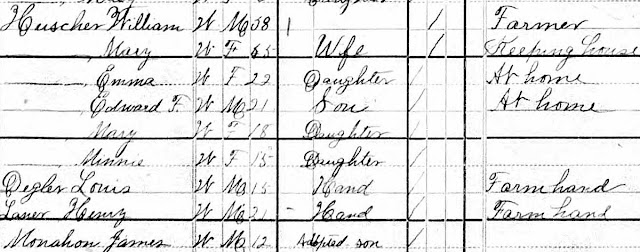
Mary Huscher mother, Mary Westerhaus, lived with the Huscher family until the end of her life, when she lived with her oldest daughter, Catherina Westerhaus Uphaus.  This has been verified by the 1860 Federal Census for Freedom, Lafayette, Missouri, and the 1870 Federal Census for Davis, Lafayette, Missouri.  

1860 federal census for Freedom, Lafayette, Missouri (William Huscher household)

1870 federal census for Davis, Lafayette, Missouri (William Huscher household)

1877 Lafayette County Missouri Plat Description (Township 49, Range 24)

1880 federal census for Davis, Lafayette, Missouri (William Huscher household)

William Huscher obituary - Higginsville Advance - 12 Sep 1895

Mary Huscher obituary - Higginsville Advance - 25 Nov 1904

William and Mary Huscher shared gravestone at Salem Cemetery (Higginsville, Missouri)

William gravestone at Salem Cemetery (Higginsville, Missouri)

Mary Huscher gravestone at Salem Cemetery (Higginsville, Missouri)


Sunday, July 14, 2024

Story of Caspar Heinrich Westerhaus and Anna Elizabeth Uphaus

Caspar Westerhaus is Peter Westerhaus older brother that immigrated to America first in 1844. He married Anna Uphaus in 1847 when she immigrated with her family to America. The Uphaus and Westerhaus family were both from the small community of Lenzinghausen, Spenge, Herford, North Rhine-Westphalia, Germany (Historical: Lenzinghausen, Herford, Westphalia, Prussia) 

As a child, Caspar moved with his family to the Westerhaus farm #14, located across from the Korfhage farm #18, in Lenzinghausen, Herford, Westphalia, Prussia during 1829.  When Caspar's family moved to the Westerhaus farm #14, the family gradually changed their last name from Korfhage to Westerhaus, in keeping with the name of the farm they had purchased.  Caspar's father, Johann Heinrich Korfhage, died 23 Sept 1835, on the Westerhaus farm #14, which he had purchased five years earlier when Caspar was ten years old.  

Caspar Heinrich left Prussia for America during 1844, without the approval of the Prussian government.  This was documented in the Herford District Departure Records.  Caspar would have been of draft age and was leaving to escape serving in the Prussian army.  This was a very common problem for the Prussian government and, if caught, Caspar's family could have been fined.  It is not known, however, if he was caught and a fine was levied or collected.

Herford District Departure Record of Caspar Heinrich Korfhage

Caspar most likely traveled from the Spenge area to Herford, 10 miles east of Lenzinghausen.  In Herford, boarded a small barge, and traveled 15 miles up the Werre River to Bad Oeynhausen.  In Bad Oeynhausen, Caspar boarded a barge of the same size or larger on the larger Weser River and traveled north for 155 miles, arriving in Bremerhaven.  Along the way, he worked for a few days or weeks to help pay for the expense of the barge trip to Bremerhaven.  Caspar boarded a sail ship in Bremerhaven for America, arriving in New Orleans, Louisiana or Galveston, Texas after sailing for 6 weeks. No passenger list has been found to document this theory. 

Once he arrived in America, He stayed a short time at the port before boarding a Mississippi River barge and traveling north to St. Louis, Missouri. Boat records were not required at this time in America and no records have been found.  

Once in St. Louis, Caspar stayed a short time before taking a Missouri River barge west to Lexington, Lafayette, Missouri.  He traveled by land to Freedom, a German community 25 miles southeast of Lexington. During 1844 or 1845 Caspar started to get established in Freedom and communicated back to his family in Prussia a safe path to follow.

Caspar Heinrich (Korfhage) Westerhaus, gradually transitioned into the name Henry Westerhaus or Casper Henry Westerhaus. Sometimes using the surname Westerhouse instead of Westerhaus to Americanize the name.

Anna Elizabeth Uphaus left with her family for America During 1847, following the same path Caspar took, arriving in port of New Orleans 11 Dec 1847. County Histories describe that the trip took two and one-half months and the family endured many hardships along the way.

Port of New Orleans passenger list for the Henry Uphaus household – 11 Dec 1847

Soon after the Uphaus family was reunited with the Westerhaus family in Freedom, two marriages occurred. Caspar Westerhaus married Anna Uphaus and Peter Uphaus married Catherina Westerhaus. Henry and Anna married on 22 Sep 1848, in Lexington, Lafayette, Missouri, according to the marriage record found at the Lafayette County Courthouse.

Marriage Record of Henry Westerhaus and Anna Elizabeth Uphaus

Henry and Anna Westerhaus settled on a farm in Freedom, Lafayette, Missouri. The farm was located at section 8, township 48, range 24. The 1850 census show them living with Ann’s parents, Henry and Mary Uphaus, along with her older brother Henry.

1850 federal census for Freedom, Lafayette, Missouri (Henry Westerhouse household)

1877 Lafayette County Missouri Plat Description for Township 48, Range 24

Henry was naturalized as a United States Citizen 29 May 1855 in Lexington, Lafayette, Missouri, based upon a Lafayette County Courthouse Naturalization Document.

Naturalization Index of Henry Westerhouse

Naturalization Document of Henry Westerhouse

Henry registered with the Union Army 9 Aug 1862.  He became a member of Regiment 71, Company C as a Private.  His unit was made up of Enrolled Missouri Militia (EMM) Volunteers.  Regiment 71 was established to protect Freedom, Lafayette, Missouri, while other Union Army units were at battles away from the Freedom area.    He served from 9 Aug 1862 until 4 Oct 1862 and was honorably discharged 12 Dec 1862 in Lexington, Lafayette, Missouri due to disabilities.   

Muster Roll of Henry Westerhouse

Henry’s pension request #1019515 dated 9 Apr 1891 indicated he had been disabled by gunshot wounds in the left arm and left side.  Henry's pension request was rejected because his injuries had not occurred during a Civil War battle.

These injuries may have occurred at the Concordia Massacre 5 Oct 1862, where sixty Bushwhackers attacked a German community.  Henry was described in this attack as being taken prisoner with eleven others.  They took the prisoners out of town by horseback, three of whom were killed, four of whom were shot but lived and four were released. Henry was one of the four who had been shot but survived.  This information was found in the book, Independent Immigrants, A Settlement of Hanoverian Germans in Western Missouri by Robert W. Frizzell.

Concordia Massacre Site – 5 Oct 1862
Southeast 6th Street and South Main Street, Concordia, Missouri

Civil War draft registration for Sixth Congressional District of Missouri - Sep 1863

During 1868, Henry was one of six investors to survey and lay out the town of Concordia, Lafayette, Missouri.  In addition to farming, he was an investor in a creamery business and a canning business in Concordia.

Henry and Anna raised nine children, Henry John (1849), John (1851), Benjamin (1854), Mary (1857), Catherine (1860), Anna (1862), Daniel (1865), Matilda (1868), Ida (1872). All children are listed in the 1870 census, except Ida, who was born in 1872.

federal census for Freedom, Lafayette, Missouri (Henry Westerhaus household)

Casper Henry Westerhaus obituary (Weekly Intelligencer) - 12 Sep 1896


Casper Henry Westerhaus gravestone
at Original Concordia Baptist Cemetery (Concordia - Freedom, Missouri)


Anna Elizabeth Westerhaus gravestone
at Original Concordia Baptist Cemetery (Concordia - Freedom, Missouri)